







Accueil | Professional air conditioner prices
Commercial Air Conditioner Prices: Understanding the True Cost of an Industrial Solution
Understanding the cost of a commercial air conditioner requires looking beyond the listed price. For a workshop, warehouse, or hangar, the cost depends primarily on the volume to be cooled and the duration of operation. Adiabatic industrial air conditioning addresses these challenges: it cools large spaces without requiring any construction work or refrigerant. At FoxAir, we design these units in France and help you assess the true cost—not just the purchase price.
What factors determine the price of a commercial air conditioner?
Several factors can affect the final cost. It’s best to identify them before comparing quotes. Each one affects the final amount, either on its own or in combination with the others.
Here are the main factors to consider:
- The area and volume to be cooled, expressed in square meters and cubic meters
- The number of devices needed to cover the entire space
- The model selected and its power rating, depending on the room's layout
- The range of features, from simple adjustments to connected controls
- The method of acquisition: purchase or short- and long-term lease
- Long-term operating costs: energy, water, and maintenance
A single FoxAir air cooler can handle areas ranging from 90 to 360 m², depending on the model. Multiple units can be combined to cover very large areas. Factories, workshops, warehouses, hangars, garages, and event venues all fall into this category. This sizing directly determines the price of the commercial air conditioners selected.
How do you determine the right size for the system in your facility?
Proper sizing prevents two costly mistakes. Oversizing drives up the bill. Undersizing, on the other hand, leaves hot spots untreated.
The calculation is based on the actual volume to be cooled. You multiply the floor area by the ceiling height to get the cubic meters. You then take into account insulation, heat sources, and openings.
The required airflow is determined by this volume. It determines the required capacity and the number of units to be installed. In a poorly insulated or very open space, a margin should be factored in.
Thanks to their casters, the units can be placed as close as possible to workstations. This allows you to target specific areas without unnecessarily treating the entire building.
Purchase Price or Total Cost: What's the Difference for Your Budget?
The purchase price isn’t the whole story. The cost of a commercial air conditioner is measured over its entire lifespan.
A traditional built-in air conditioning system involves multiple expenses. In addition to the purchase price, there are costs for fluid maintenance, annual regulatory inspections, and technician service calls. These expenses continue as long as the unit is in operation.
The FoxAir air cooler works in the opposite way. With no compressor or indoor units, it requires no refrigerant maintenance contract. Its washable filters simplify maintenance and reduce operating costs.
Why does installation affect the price of a commercial air conditioner?
Installing a traditional air conditioning system accounts for a major portion of the cost. Drilling holes, running ductwork, and the construction work keep a crew busy for several days. With a ducted system, the bill goes up even before the system is turned on for the first time.
In contrast, a FoxAir unit can be up and running in 24 to 48 hours. No drilling, no plumbing: just plug it in, fill the tank, and start it up. This simplicity significantly reduces the final cost.
Adiabatic or Conventional Air Conditioning: What Are We Really Comparing?
To compare two technologies, you need to consider the same scope. A reversible air conditioning system and an adiabatic cooler do not address the same need.
Reversible, split, or ducted air conditioning systems produce cooling in a closed loop using a compressor and refrigerant. They require fixed indoor units and a confined space. This system is designed for the precise cooling of an enclosed room.
The evaporative cooler works differently. It continuously refreshes the air instead of recirculating it. Unlike a monobloc or single-split air conditioner, which is designed for small spaces, it covers several hundred square meters.
The right choice depends on your specific needs. For large spaces—whether open or difficult to enclose—this solution remains the most cost-effective option. This is precisely where FoxAir devices shine.
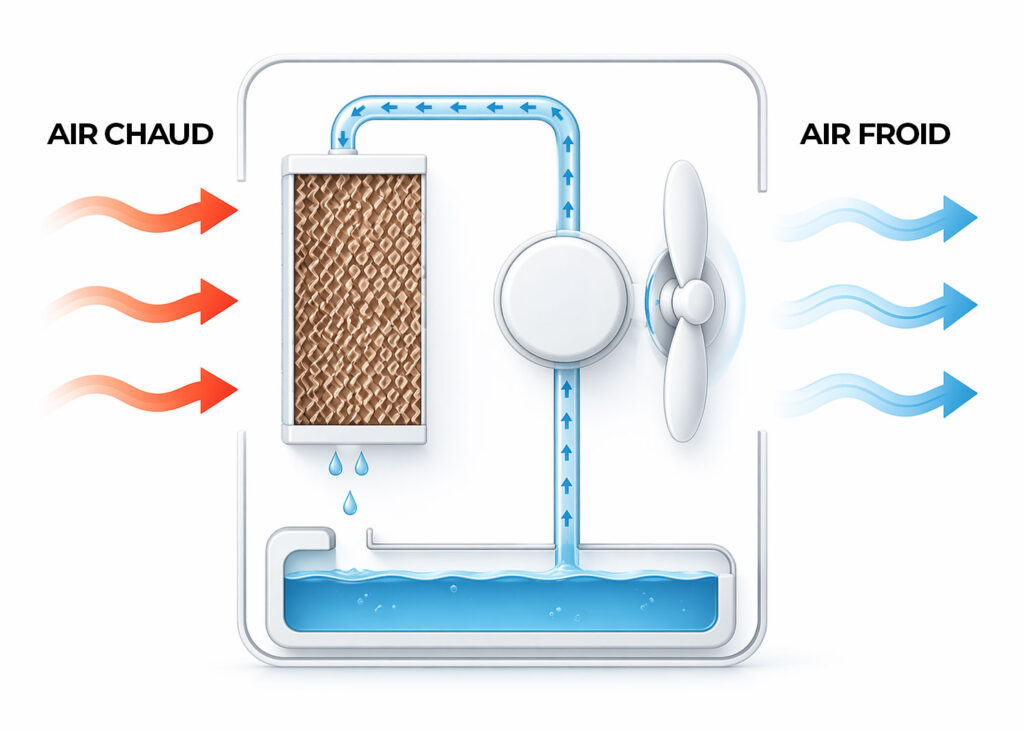
Why does adiabatic cooling reduce energy costs?
Energy remains the biggest expense in the long run. This is where the cost of a traditional air conditioning system begins to fall behind that of an adiabatic system.
The principle is natural. As water evaporates, it absorbs heat from the air and cools it without the use of chemicals. A fan draws in dry, hot air, passes it through a moistened filter, and then releases it back into the room, cooled.
The benefit is tangible. An adiabatic cooler consumes up to ten times less energy than a conventional system. With no refrigerant or heat pump, it becomes more energy-efficient as temperatures rise. It also increases humidity levels, providing greater thermal comfort for staff.
What features make the investment worthwhile?
A commercial air conditioner is not just a fan. The cost of a commercial air conditioner is justified by its features and lifespan.
The FoxAir 250 and FoxAir 350 models feature advanced functions:
A color touchscreen to control everything right from the device: settings, programming, and real-time monitoring
Control of room temperature or supply air temperature, depending on your needs
Managing and limiting hygrometry, that is, the humidity level in the air
Air Treatment Using Antibacterial UV-C Light
Programming and remote control via connected features.
These devices are designed and manufactured in France, in the Auvergne-Rhône-Alpes region. Each unit undergoes 109 quality checks before shipment. Durability, low noise levels, and casters round out the package. You’re investing in a controllable, sustainable solution—not in disposable equipment.
In what types of work environments should it be installed?
These portable air conditioners are intended exclusively for professional and industrial use. They are not suitable for residential use.
They are the go-to solution wherever a fixed installation reaches its limits. Manufacturing plants and production facilities gain greater convenience without interrupting operations. Warehouses and logistics hubs can handle large areas at a lower cost. Hangars, car dealerships, and garages benefit from immediate setup.
The events industry also benefits. Tents, trade shows, and temporary venues require a mobile solution that can be deployed quickly. Public venues and local governments round out the list of relevant environments.
Poorly insulated spaces, hard-to-reach areas, and unusual layouts: these are the situations where mobility makes all the difference. You can move the unit to where the heat is concentrated.
Buying or Renting: Which Option Should You Choose?
The purchase plan is tailored to your business needs. There are two options available, depending on your project.
Purchasing is a long-term investment. It meets recurring needs, season after season. Renting—whether short- or long-term—helps balance your budget and addresses occasional spikes in demand. This is how the cost of a commercial air conditioning unit can be tailored to your cash flow.
At FoxAir, our technicians conduct a thermal analysis of your facilities. This assessment ensures the solution is precisely sized—neither oversized nor undersized. You will then receive a customized quote tailored to your space and specific requirements.