







Accueil | Air cooler comparison
Air cooler comparison: the FoxAir advantages
With climate change, companies now face critical summer temperatures. How do you protect teams and equipment when the heat reaches 35 or 40°C? FoxAir offers a comparison of air coolers to help you find your way.
What are the different types of professional cooling equipment?
There are several models of industrial air coolers, which do not meet the same requirements.
The wrong choice has consequences for costs, efficiency and operating comfort.
Here are the four categories of air conditioners and air coolers:
How to read our air-cooling solutions comparison chart?
Each piece of equipment responds to a different logic in terms of installation complexity, cost and efficiency.
A first common mistake is to focus solely on the purchase price. For example, if the overall cost – installation, operation, consumption and maintenance – is taken into account, low-cost solutions lose their apparent financial advantage.
Our table enables you to compare industrial air coolers on the basis of the most important criteria:
- Initial investment
- Operating costs
- Energy consumption
- Care and maintenance
- Flexibility of use
- Real comfort (thermal gain, hygrometry, air quality, etc.)
- Adapting to challenging environments
Which cooling solution is right for your business environment?
FoxAir coolers are clearly differentiated from other equipment and technologies.

Professional air cooler or traditional air conditioning?
Industrial air conditioning provides overall thermal comfort and precise temperature control. On the other hand, it implies strong constraints:
that impact business
and impossible to implement in a hurry
(many wearing parts, presence of refrigerant...)
(25 kW for 1,000 m² at best), which means high running costs.
Conventional industrial air-conditioning is relevant in closed environments with very stringent requirements. It’s the best option if you need a constant temperature of 21°C in summer and winter, for example.
On the other hand, this system is unsuitable for large industrial volumes or open and semi-open spaces.
Professional air freshener or low-cost model?
The problem is different. Faced with a technical data sheet that advertises a similar airflow for a price three times lower, companies wonder… The differences are real, however:
- Thinner heat exchangers on low-cost models: for a room temperature of 35°C, the low-cost unit delivers a reduction of 7 to 8°C, compared with 15°C for a FoxAir model.
- Less powerful motors and water pumps: as filters are finer, evaporation flow is also lower - as is cooling capacity.
- No after-sales service: low-quality design and materials lead to breakdowns, breakages and other malfunctions. Spare parts are in short supply, and service is non-existent.
- Lack of regulation: entry-level models offer no means of fine-tuning temperature or humidity, two important parameters in most industrial activities.
High energy consumption, noisy
Vibrations, noise
Fragile PVC
Limited use
Fixed speeds
Limited performance
Corrosion-sensitive steel

30% less energy consumption, silent, maintenance-free
Balanced, vibration-free, high quality
Highly resistant recycled PE
Suitable for dirty water, intensive use
Precise setting + timer
Superior efficiency down to -15°C
Stainless steel/Alu, corrosion-resistant 10 years

FoxAir mobile air cooler or fixed adiabatic system?
At first glance, the two systems are identical. They use a technology that transfers heat from the air to water, which is evaporated to capture the heat and cool the outgoing air. The essential difference lies in the installation of the unit on the roof.
A fixed installation uses outside air, which is often very hot on the roof, limiting its effectiveness during the day. A mobile adiabatic cooler, on the other hand, recycles cooler indoor air and becomes more and more efficient with each passing hour.
What’s more, cooling is much faster, because the device acts directly at operator level, whereas a fixed installation must first cool the layers of hot air above.
Finally, fixed roof-mounted solutions have the same technical constraints as industrial air-conditioning systems: opening or modification of the roof, frames, waterproofing, water and electricity connections… This solution seriously lacks flexibility when the temperature needs to be lowered urgently.
What are the advantages of FoxAir solutions for cooling work environments?
The design of our mobile air coolers is based on a need in the field: to rapidly improve working conditions without heavy investment. To achieve this, our tailor-made solution offers a number of key advantages:
Deployment in 24 to 48 hours
and business interruption
Ability to target really useful areas
Adapting to business constraints
(control, connectivity, UV disinfection...)
Where can FoxAir coolers prove their superiority?

In a welding shop, the temperature rise is rapid and severe. Operators are tempted to remove their PPE, creating a real safety risk. The FoxAir solution provides an immediate response, protecting teams and improving their working comfort.
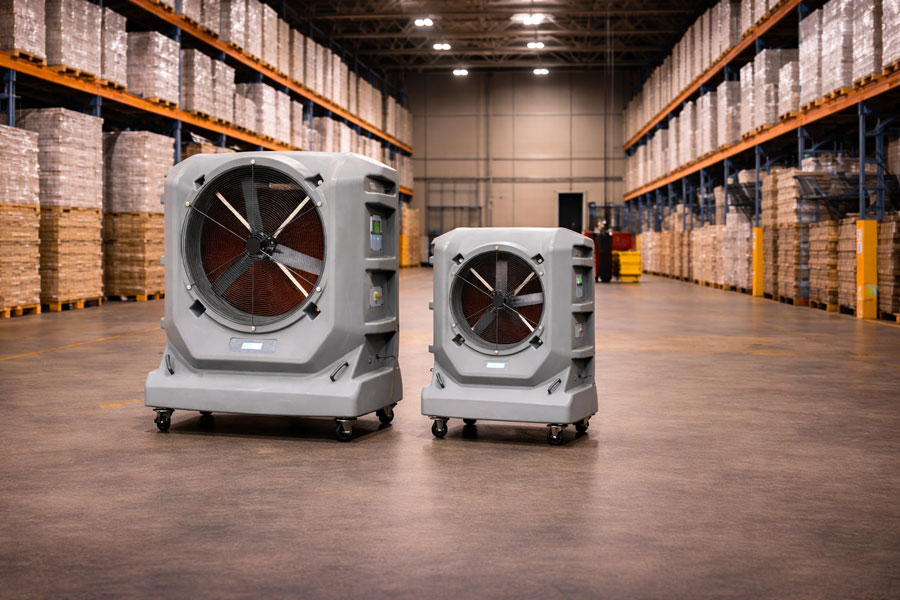
In open or semi-open warehouses with large volumes, the mobile solution enables targeted action. Critical workstations, IT systems, etc. can be refreshed.

In demanding environments - foundries, rotational molding companies - or high-precision environments - aeronautics, electronics - the use of premium equipment ensures reliable, long-lasting operation. FoxAir coolers resist temperature variations, heat, solvents, the weight of water, dust and industrial residues...
FAQ
Is humidity a problem?
No, in fact, the new-generation FoxAir coolers feature humidity control.
Is the FoxAir solution effective in hot weather?
Yes: the higher the ambient temperature, the more efficient the coolers.
Can adiabatic coolers be used all year round?
Yes, because they are effective at ambient temperatures as low as 15 or 16°C.
Is evaporative cooling right for my business?
FoxAir offers 360° solutions for industry, livestock, food processing, local authorities, events, sports…