






Air Cooler or Air Conditioner: Which Should You Choose for Your Large Premises?
News / Air Cooler or Air Conditioner?
Every summer, extreme heat puts your facilities to the test. In a workshop, warehouse, or production hall, temperatures rise quickly. Employee comfort declines, and so does productivity.
There are two competing solutions for cooling these large spaces. Should you choose an air cooler or an air conditioner? This article compares the two technologies and helps you decide.
FoxAir presents these two solutions and offers its advice.
What is adiabatic cooling?
The adiabatic cooler operates on the principle of evaporative cooling. The fan draws in hot, dry air, which passes through a moistened filter. As the water evaporates, it absorbs heat. The air emerges cooler and slightly moistened.
No compressor or refrigerant is involved. You fill the tank and plug in the unit—no installation or construction work required. This is the principle behind the adiabatic air conditioner, also known as an air cooler. It lowers the temperature by 2 to 8 °C. The hotter and drier the air, the more pronounced the effect.
How does a conventional air conditioner work?
The air conditioner operates on a closed refrigeration cycle. A refrigerant changes states to transfer heat between four components: the compressor, condenser, expansion valve, and evaporator. The heat is released to the outside.
This system precisely controls the temperature using a thermostat and dehumidifies the air. Several models are available: the portable monoblock air conditioner with ducting, the single-split system, the multi-split system, and ducted, reversible models.
What criteria distinguish these two solutions?
In everyday use, the difference between a fan and an air conditioner can be seen in several ways. Here are the criteria that matter for professional use.
- Control: The air conditioner sets a specific temperature; the adiabatic process creates a sensation of coolness without any regulation.
- Energy: Without a compressor, it uses up to five times less electricity.
- Cost: no installation required on one side; professional installation costing between €500 and €3,000 on the other.
- Maintenance: Simply cleaning the tank and filter versus a thorough inspection of the refrigeration system.
- Humidity control: one increases humidity, which is beneficial in dry air; the other dehumidifies.
- Environment: No refrigerant, no heat discharge, and a reduced carbon footprint.
- Noise: 60 to 66 dB on the evaporation side, compared to up to 76 dB for a compressor.

Air Cooler or Air Conditioner: Which One Should You Choose Based on Your Business?
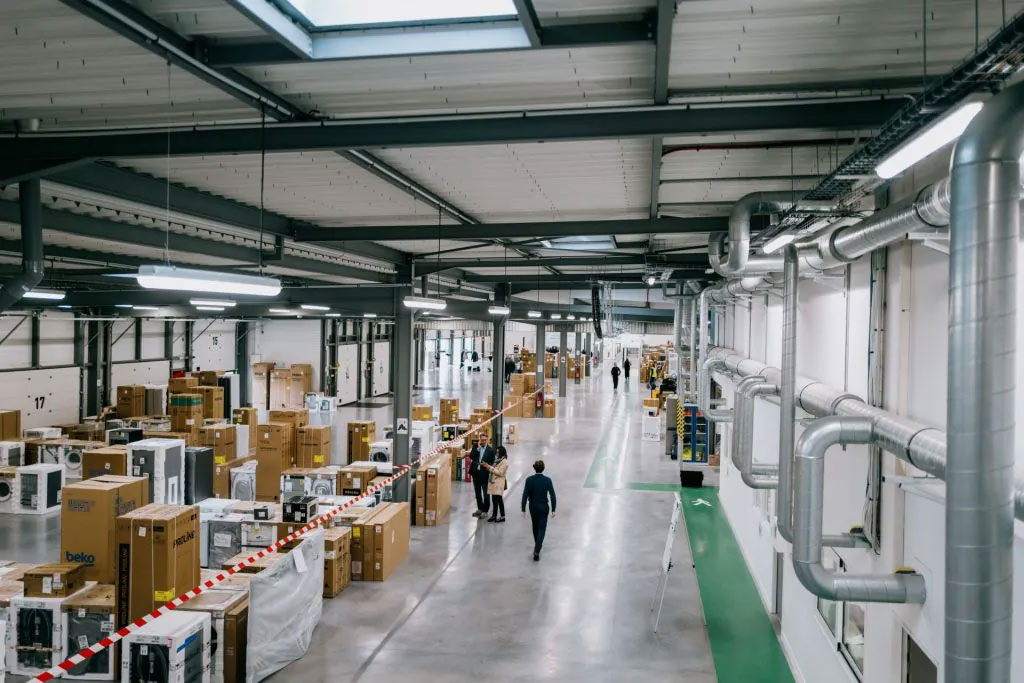
Comparing an adiabatic cooler to a conventional air conditioner only makes sense in light of your specific needs. Evaporative cooling is ideal for large, open, and well-ventilated spaces: workshops, warehouses, hangars, and industrial halls. Mounted on casters, the unit can even cool hard-to-reach areas, while keeping costs and energy consumption under control.
Air conditioners, on the other hand, have the advantage in enclosed and insulated spaces. A room that requires a constant temperature or a sensitive computer room calls for precise temperature control. But in very large open areas, a fixed installation is often unsuitable or even beyond the budget. The mobile solution then covers the space zone by zone.
Why choose the FoxAir solution to cool your facilities
?
At FoxAir, we design and manufacture portable adiabatic coolers in France. A single unit can cool up to 360 m², and multiple units can be combined. Setup takes 24 to 48 hours and requires no construction work.
Our professional air cooler breaks the mold of entry-level models. The new generation of FoxAir 250 and 350 units features a color touchscreen interface for temperature control, humidity management, and antibacterial UV treatment. Built to last, our units undergo 109 quality control checks. In industrial settings, the air cooler is the most effective solution compared to air conditioners.
Every site is unique. To determine the right size for your system, request a thermal analysis or a customized quote. Our experts will advise you on model selection and layout.


Would you prefer a portable cooler or an air conditioner?
We hope this comparison has been helpful. And if you need a professional solution for your facilities, FoxAir offers a range of portable air coolers.
Share this article