






Accueil | Ressources | Efficient air coolers: 8 technical points to check
Efficient air coolers: 8 technical points that distinguish professional equipment from entry-level solutions
Choosing an efficient air cooler for a professional site means going beyond the technical data sheet. Two units with comparable air flow rates can differ in real-world performance by as much as 1 to 3. Eight design points explain these differences. This guide deciphers the two most decisive and lists the other six to check.
Overview

Why two air coolers at the same price don't deliver what they promise
On the market, equipment with similar characteristics can present radically different performances once installed on site. Industrial managers who have tried low-end equipment confirm this: the actual delta T (temperature gain) does not correspond to that advertised, the noise becomes annoying within a few months, and the machine breaks down without any possibility of rapid repair.
The difficulty is that most of the reviews available online relate to domestic use or small premises, which are not easily transposable to an industrial environment. This guide, on the contrary, takes a BtoB field approach and details the 8 design points that really explain performance differences.
The 8 technical points at a glance
Here’s a complete mapping of the 8 design points to check before making any purchase decision on a professional air cooler:
(150 mm vs. 75 mm)
(industrial pump vs. aquarium pump)
(EC brushless motor vs. undersized motor)
(rotational-molded polyethylene vs. PVC)
(stainless steel vs. standard steel)
(IP54 and higher vs. lower classes)
(UV-C lamp on board or absent)
(structured network vs. service-free reseller)
These 8 points do not carry the same weight. According to our experience in industrial contexts, two points alone account for over 60% of the difference in actual performance observed between equipment: the thickness of the adiabatic exchanger and the type of pump. These two points are discussed in detail below. The other six are described in detail in the downloadable PDF guide at the end of this page, with technical diagrams and an opinion structured by criterion.
The most decisive point: the thickness of the adiabatic heat exchanger
The adiabatic exchanger is the technological heart of an evaporative cooler. Hot air passes through it to be humidified and cooled. Its role is to break down the air pressure so that water can evaporate at useful temperatures.
In physical terms, the thicker the exchanger, the greater the pressure drop generated, and the more evaporation can be triggered at low temperatures. On high-quality professional equipment, the exchanger is 150 mm thick. On low-end equipment, it’s 75 mm, or half that. This difference is not insignificant: it determines the temperature range over which the equipment is really effective.
In concrete terms: a 150 mm exchanger starts to produce a temperature gain from 15-16°C ambient and delivers a gain of 6°C from 25°C outside, 10°C at 30°C, and 15°C at 35°C. Equipment with a 75 mm exchanger only starts to produce a significant gain from 25°C ambient, and only reaches the same level of performance at 35-40°C. Over a full summer season, the difference in useful operating hours is considerable.
To obtain a comparable air flow through an exchanger twice as thick, you also need a motor twice as powerful. Which brings us to the second decisive point: coherence between the exchanger and its surrounding components.
The second decisive point: the type of pump
In an adiabatic cooler, the pump circulates the water that humidifies the heat exchanger. Its quality directly conditions the reliability of the machine and the quality of humidification.
On quality professional equipment, the pump is an industrial pump designed to operate with charged water (the water circulating in a cooler progressively contains dust particles captured from the ambient air). It is made of stainless steel or equivalent material, designed for thousands of hours of operation, and incorporates safety devices (dry-running protection, thermal threshold).
On low-end equipment, the pump is often a hijacked aquarium pump. Designed to operate in clear water, at low flow rates, for residential use, it has neither the robustness nor the sizing required for an industrial environment. The consequences are quickly apparent: clogging within a few months, gradual drop in water flow rate, deterioration in heat exchanger humidification and consequent drop in cooling performance, followed by permanent failure with no possibility of replacing parts.
An industrial manager carrying out a real test on an air cooler should ask to see the pump, check whether it is industrial or aquarium-grade, and ask the supplier about the availability of spare parts. This simple exchange is often enough to distinguish between serious and approximate equipment.
Beyond the datasheet: how to carry out a real test of an air cooler
These first two technical points suffice to demonstrate that a true evaluation of an efficient air cooler cannot be made solely on the basis of a data sheet. A relevant opinion is based on a technical visit to the supplier, inspection of the components, and verification of actual test conditions.
To compare several market solutions objectively using this field-based approach, take a look at our comprehensive air-cooler comparison, which compares 4 families of solutions based on verifiable criteria.
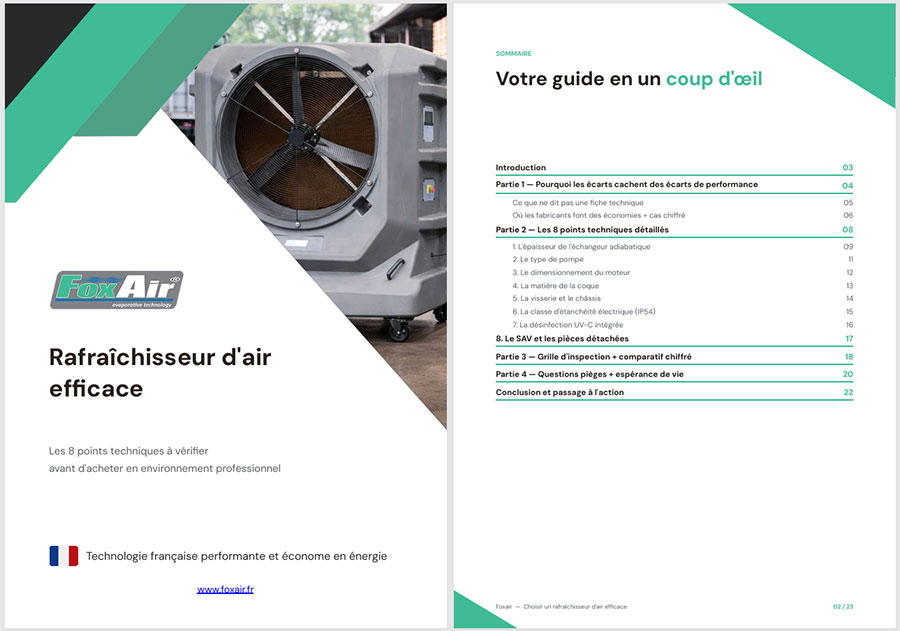
Download the complete guide: the 6 other technical points + structured advice
This page has detailed the two design points most decisive in the real efficiency of an air cooler. The complete PDF guide covers all 8 points and provides the tools you need to build your own technical assessment:
The 6 points not covered on this page (engine, hull, screws, waterproofing, UV-C, after-sales service)
Cutaway diagrams for each critical component
A visual inspection grid for use during a supplier visit
An 8-point costed comparison between professional and entry-level equipment
5 trick questions to help you spot a supplier who's not up to scratch
A table of life expectancy by component and range level
To find out more about your project
If you would like to take a closer look at your decision, see also :
They put their trust in us