






Accueil | Ressources | Which air cooler to choose? 7 criteria to help you decide
Which air cooler to choose for a professional site: 7 decision criteria
Knowing which air cooler to choose is becoming a strategic issue for any industrial decision-maker faced with increasing thermal constraints. Between volumes to be treated, business constraints and operating costs, the decision deserves a structured method. Here are the 7 criteria that make the difference, two of which are too often underestimated in supplier consultations.
Overview

Why choosing an air cooler deserves a structured approach?
In the professional cooling market, technical data sheets are similar, commercial promises are aligned, and price differences can range from 1 to 5 for seemingly similar equipment. For a production manager, technical director or buyer, this opacity makes for a complex decision.
The wrong choice has direct consequences: unresolved drop in productivity, diluted investment in underperforming equipment, unplanned maintenance, teams always exposed to the heat. There is no universal answer to the question “Which is the best air cooler? It is answered by configuration, by profession and by constraint. This resource provides an analysis grid to help you build your own answer.
The 7 criteria at a glance
Before going into detail, here’s a complete mapping of the 7 criteria that structure a relevant decision in professional refreshment:
to the volume and configuration of the site
temperature and humidity
and equipment mobility
over 5 years (TCO)
and the impact on business continuity
and real sustainability
(after-sales service, support, advice)
These 7 criteria do not carry equal weight in the final decision. In our experience of industrial consultations, two of them are systematically undervalued: regulation capacity and total operating cost. It is precisely these two criteria that we describe in detail below. The other five criteria, as well as a complete self-assessment grid, are developed in the PDF guide downloadable at the end of this page.
The often overlooked criterion: temperature and humidity regulation capacity
Most industry consultations focus on airflow and surface coverage. Few specifications explicitly address the question of regulation. Yet this is one of the most differentiating criteria between professionalized consumer equipment and a genuine industrial solution.
The evaluation is structured around two questions. The first is whether the equipment can regulate room or supply air temperature, as required. This switch is useful. In a large volume, supply control is more relevant (you control what the machine produces). In a confined space, room control is preferable. Most equipment on the market offers just one mode.
The second question is even more rarely asked: can the equipment set a maximum humidity threshold beyond which evaporation stops automatically? This function is critical in sensitive environments (plastics, electronics, aeronautics, printing), where excessive humidity can lead to production faults, paper jams or altered processes. Few systems on the market today offer this level of control.
For industrial decision-makers, asking these two questions to their suppliers is the quickest way to distinguish between serious and approximate solutions. The PDF details the critical thresholds by sector of activity, and the concrete consequences of regulatory failure.
The often-misjudged criterion: total operating costs over 5 years
The purchase price is only one component of the cost of a cooling project. The real decision-making indicator is the TCO (Total Cost of Ownership) over 5 years. It incorporates six separate items: initial investment, installation, energy consumption, maintenance, consumables and indirect costs linked to non-performance (stoppages, production faults).
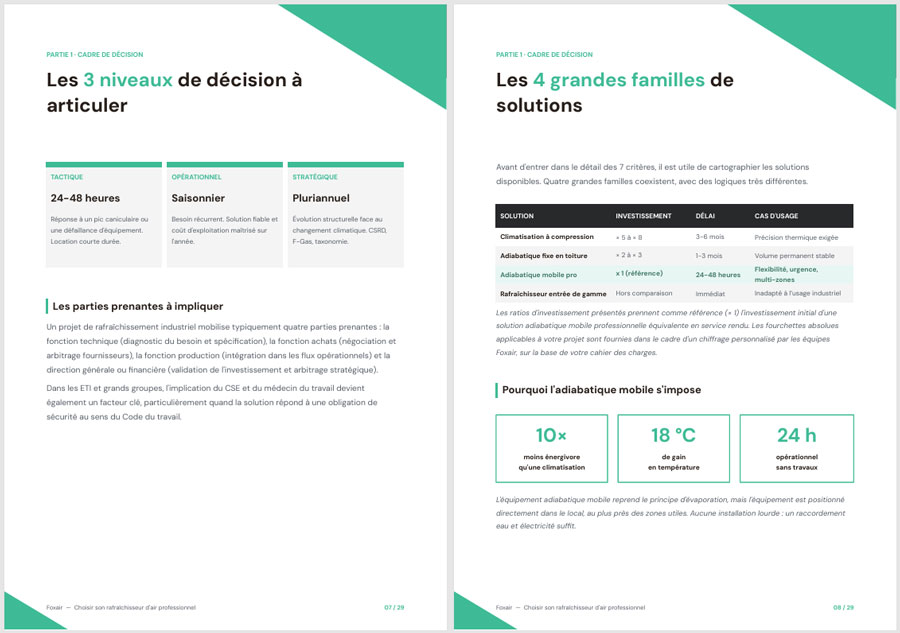
The most significant difference between technologies lies in energy consumption. To cool an identical volume, conventional industrial air-conditioning consumes around 10 kW of electricity, whereas an efficient adiabatic solution consumes 1 kW. The ratio is 1 to 8, and sometimes 1 to 10, depending on the configuration. Over 5 years, with an industrial electricity price of around €0.15/kWh and 1,000 hours of annual operation, the difference in consumption amounts to several tens of thousands of euros.
Equipment that costs 30% less to purchase but consumes three times as much energy costs more after 18 months of operation. Premium equipment, better sized and regulated, typically pays for itself between 24 and 36 months on an industrial site exposed to recurring thermal constraints.
The classic pitfall of supplier consultations is to compare purchase prices without constructing a true 5-year TCO. Buyers wishing to defend their trade-offs internally have every interest in reasoning in terms of full cost. The detailed calculation method, with 3 simulated figures, is the subject of a dedicated resource in our resources area.
Air cooler or air conditioner: the decision framework question
The question of “air cooler or air conditioner” comes up again and again in industrial projects. The answer depends on three parameters: the thermal precision required (absolute setpoint or temperature gain), the volume to be treated (air conditioning quickly becomes unsuitable above 2,000 m²) and the budget available for operation.
The difference between air conditioners and air coolers lies less in the physical principle than in the constraints of use and TCO. For a more in-depth comparison, take a look at our complete air cooler comparison, which compares the 4 main families of solutions available on the market.
Download the complete guide: the 5 other criteria + self-assessment grid
This page has detailed the two criteria most often underestimated in industrial consultations. The full PDF guide develops the 7 criteria in full, and provides the activatable tools that are missing from most of the resources available on the subject:
The 5 criteria not covered on this page (sizing, flexibility, lead time, manufacturing quality, service level)
A 15-question self-assessment grid to adapt to your site
3 quantified use cases developed (500 m² plastics workshop, 1500 m² logistics warehouse, 3000 m² aeronautics hall)
A synthetic decision matrix ready to integrate into your specifications
7 pitfalls to avoid when consulting suppliers
Printable supplier analysis grid template
To find out more about your project
If you would like to find out more about a specific aspect of your decision, see also :
They put their trust in us